

South Florida is one the most popular tourist destinations, but it’s not known for its hiking. In this blogpost, I invite you to join me on a scenic trail that proves that hiking in South Florida is exciting even though it’s as flat as it gets.

This 8-mile section of Florida trail goes through various landscapes of Big Cypress National Preserve. About a year ago, I went to Florida with my sister, and we stayed at the same CouchSurfing hosts, as in my first visit to Florida with Joe; Peter already knew we would love the idea of hiking in the swamp, so he got in touch with his friend Dave from Florida Great Outdoors group. Dave was an excellent guide, he knew every corner of the trail and told us a lot about the wildlife, of which we saw plenty!

Just on the way to the southern trailhead, we saw various birds, from a cormorant with a fresh catch to great egrets wading between cypresses.

Dave knew that we were unlikely to encounter too many other hikers, so, almost immediately after the start of the trail and getting ourselves familiar with its rules, we got naked. Given the muddiness of the trail and hot weather, it was clearly the best way to go!

In the beginning (coming from the South), the most typical landscape is grassland with a few scattered cypress trees. But unlike prairie or savannah, this grassland is flooded, with water levels varying throughout the year and depending on weather conditions. On this trail, we could really see why the Everglades are called the “river of grass” (the whole southern part of Florida practically represents a giant swamped slow-moving river). Besides the sawgrass marsh, we also went through the pine forest and cypress swamp. On the photo below, you can actually see the so-called cypress dome in the background. It is formed when pond cypress trees grow higher in the center than on the edges of the swamp, which can happen due to various reasons.

Our first encounter with an animal on the trail was a snail.

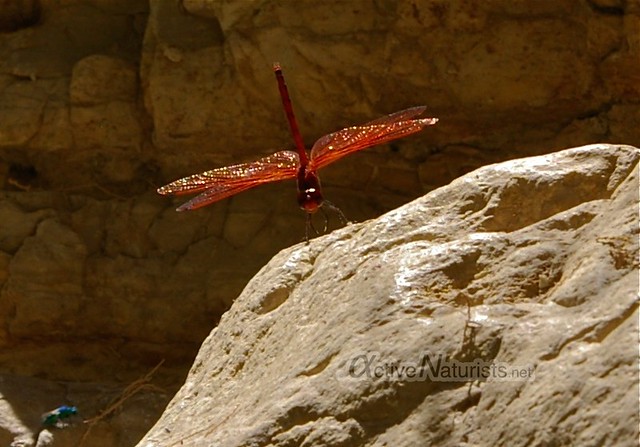
There were many dragonflies

and grasshoppers,


one of which devoured on a flower 🙂
Speaking of flowers, maybe we were lucky with the season, but there were quite a few plants blooming:
white star sedge (a sawgrass species),

milkweed,

Hymenocallis,

and marsh roses (Sabatia) – pink


and light-blue.

Bromelias were blooming too,

but even when they weren’t, they served as a nice decoration on cypress and pine trees.

At some point, palm trees appeared more frequently between the pines, but we could tell that the first one wasn’t in the best condition… which made me look like a giant next to it.

That’s where we saw some Carolina anoles too. I was too slow with my camera and only got one hiding in a hole in the tree and missed how it changed colors while moving across different surfaces (for this ability, they are nicknamed american chameleons).

Midway, pine and palm forest got denser and we stepped on solid soil for the first time in a couple of hours. This is also the only place on the trail that is suitable for camping; we had our lunch break there.

We couldn’t rest for too long, however, and soon followed the trail further through the swamped cypress forest.

When we reached the cypress dome, we could see how the tallest pond cypress trees indeed surrounded the central pond, with many tropical understory plants mingled between them.

We almost missed our second reptile encounter, a snapping turtle, as it was well-concealed in the mud. Being much better protected than a lizard, it didn’t feel the need to run away from us but looked cautiously; considering the name of the species, we didn’t approach it too close though.

Then there was a stretch of the trail that went through fern thickets taller than human.

And some open water again, where we could see the odd cypress ‘knees’ (I saw many more of those in the Mississippi swamps near New Orleans).

Usually, I don’t post pictures of people in clothes due to the nature of this blog, but my sister deserves a credit because later on this trip she did get naked in a public place for the first time in her life (at Haulover beach), and here in the swamp she looked pretty cool and odd at the same time in her white night dress (she thought if she didn’t get naked she should wear the lightest thing she had…)

The rest of us were content with our naked attire… As you can see on these photos, the cypress forest after the dome became more flooded, and the rest of the trail we hiked in ankle-deep water, which actually felt nice.

Then, we had our third reptile encounter, or actually two but of the same species.

This was a venomous snake, water moccasin. They are territorial and feel safe with their venom-filled fangs, so they didn’t show a sign of retreat, but thankfully they did show their warning display. So we just stood there and looked at each other for a few minutes, and who knows who of us was more scared… Well, there is no use for them to bite humans unless attacked, so I guess we could call it mutual respect.

It also provided enough time for taking pictures 😉

Soon after that, we could hear the noise of Tamiami road; it didn’t make sense to put on clothes in the end of the trail just to make it dirty, as it was still muddy, but that’s what we had to do.
In the pond by the visitor center, we had our fourth reptile encounter. A group of american alligators were sunbathing and just waiting to be photographed.

Thus, we saw representatives of the major groups of reptiles on one trail!

And as a bonus, while picking up the car, we saw some more wading birds: wood stork (above) and great blue heron (below).

Florida doesn’t really need much publicity for tourism with its climate, beaches, festivals and Disney World, and it probably has more nudist colonies than any other state, but there is definitely more to it! This trail was perfect to discover Florida’s wild side and see the “river of grass” that it really is. Next, we’ll show you the place where this river meets the sea.
PS Keep in mind that Big Cypress National Preserve is also a home to black bears and elusive Florida panthers (a subspecies of cougar)!


 caves
caves












 Active Naturists