canoeing in the Everglades

You might have been surprised to hear about a hiking trail in South Florida in my previous blogpost, but did you know that you could go canoeing in the Everglades for a week or so without seeing any settlements? That is the largest continuous mangrove forest in western hemisphere for you! On our latest trip to Florida, Tam and I didn’t have quite as much time, but we ventured out to explore the southern part of the Everglades National Park for 3 days on a canoe. That’s where the “river of grass” I was talking about in my previous post meets the sea, but at this point it is no longer dominated by sawgrass but mangroves, a unique group of trees that can grow in brackish and even sea water (I wrote more about them previously). The canoe trail goes from Flamingo Visitor Center in the south to Everglades city, and there are multiple campgrounds along the way. As you may wonder how one would be able to camp in the mangroves, it’s better to reveal the solution right away – chickee.

naturist 0003 Everglades, Florida, USA

These are simple above-water wooden structures consisting of raised floor and roof adapted from Seminole (local Native American tribe) design; porta-potty is an important modern addition, though. As we didn’t have time to do the whole trail, we just planned our route based on availability of chickees in the vicinity of Flamingo visitor center. It turned out to be a good idea to arrive in the afternoon the day before, so we could reserve our spot on chickees and have 3 full days of canoeing. We were told that it would take about 6 hours of paddling to get to the nearest chickee, in Hells Bay, but rarely people did paddle there all the way from Flamingo and preferred to be rather dropped off at a closer location, from which they could use another path. We were happy to do all the way by canoe though, that was why we came there for. It’s worth noting that the campground at Flamingo has the best kind of grass for camping, it felt very comfortable to sleep even without any mats. The night was pretty cold (by South Florida standards!), the first cold night of this winter, but the forecast looked promising for the next days. The morning was much warmer indeed, but there were some rain clouds around. Tam and I rented a canoe, and Peter, who could only stay for a day, got a single kayak. We also bought a very detailed map of the area, which is a must if you plan a trip like this. People at boat rental sounded a bit surprised that we were going to paddle to Hells Bay from there, but we trusted the park ranger who said we would be able to do it. Off we went, and it started raining. Luckily, I was clever enough to take my waterproof bike pannier “Ortlieb”, where we could store the essentials. Our food provision  consisted of dried cretan barley bread, banana bread, nuts and a box of tropical fruits that we bought at “Robert is here” farmer market.

It took us about an hour to go through the first canal, and somewhere midway I took off my shorts, as they got soaked in the rain and didn’t serve any purpose. When we reached the first area with open water – Coot Bay, Peter decided to head back to Flamingo. The rain was losing power and turned into a calm warm drizzle. Then I briefly saw a fin sticking out of water, and I was quite speechless, as it was very close to us and I couldn’t figure out whether it was a shark or a dolphin. But not for too long – we heard a sound of deep exhale and saw another fin, it was clearly a dolphin. We followed it for a while and saw that there were a few more closer to the shore. We even saw one jumping out of water in a distance. Then three of them were swimming towards the channel where we had to go too. It was amazing to see dolphins so close and hear how they breathed, thanks to quietness around.

dolphins 0000 Everglades, Florida, USA

After that, we went through another, even bigger, Whitewater Bay and then East River. We enjoyed navigational aspect of canoeing both in the open water and narrow winding river. Overall, it took us just 4.5 hours to reach Hells Bay chickee from Flamingo, but we weren’t the only ones to arrive. Just when we entered Hells Bay, we saw a group of 5 canoes with 10 people  approaching the chickee too. They docked all at one side and we took the other. I was still naked and decided to give it a try – I really didn’t want to put on my wet shorts. I noticed a couple of stares and put on my sarong for a while, but it didn’t hold well while we were pitching the tent. One guy from the group came to us though, and asked me to put on some clothes in a semi-awkward semi-appologetic manner, explaining his request by the presence of “college girls”. Later he came back not but once but twice, as he wanted to stay on friendly terms with us. It turned out they were from Outward Bound School, and he said he and his fellow instructor were personally cool with nudity but the girls apparently weren’t; we didn’t feel like having a lengthy discussion as to whether girls of college age should be familiar with male anatomy and why the mere sight of a naked man doing random things like pitching a tent should be seen in any way offensive. On the second time, he gave us a compass; we had one too, but his was more convenient to use with the map. He gave us a couple of navigation tips too. Before the darkness fell, we went on a short trip to explore the surroundings and saw an alligator swimming not too far from the chickee.

alligator 0000 Everglades, Florida, USA

Three more people came to the chickee in the evening, but apparently there was a mistake with reservations, as  such chickees are not meant for more than 12 people. Luckily those guys seemed to know the area and didn’t mind to go further to another chickee.

As we went to sleep, we realized that it was a big mistake not to bring any kind of padding to put under sleeping bags… Chickee floor is hard wood, and it’s not something I’m used to when I go camping, so it didn’t even occur in my head to bring something soft… Somehow, we managed to sleep well, probably due to tiredness from paddling, and by the time we woke up, the Outward Bound School team had already left. We started the day with planning out the route, Tam definitely liked to work with our new compass.

naturist 0000 Everglades, Florida, USA

There were just a few clouds,

view 0000 Everglades, Florida, USA

but one of them did produce a short rain.

naturist 0001 Everglades, Florida, USA

It remained very warm, and we just enjoyed the sound of rain and the view of the bay from under the roof of the chickee.

view 0001 Everglades, Florida, USA

As the sun came out, we gave it a proper salutation 🙂

naturist 0002 Everglades, Florida, USA

We definitely needed some good stretching, and partner exercises worked great for us.

naturist 0004 Everglades, Florida, USA

We were almost sad to say good-by to our first chickee, but we knew we had a great day ahead.

naturist 0005 Everglades, Florida, USA

We stopped by for lunch at another chickee, in Lane Bay, and then continued our way towards Whitewater Bay. We noticed that for some reason one bank of the channel had smaller and younger mangrove trees than the other.

mangrove 0000 Everglades, Florida, USA

When we entered the Whitewater Bay, it was much more difficult to paddle due to wind and currents. It was also more difficult to navigate with few landmarks around. But at least the day was a perfect combination of clouds and sun.

view 0002 Everglades, Florida, USA

We didn’t see that many birds to our surprise (apparently, there are some bird colonies further up north of the Whitewater Bay), but there still was some variety.

great egret 0000 Everglades, Florida, USA

A great heron let us approach it pretty close.

american white ibis 0000 Everglades, Florida, USA

We saw quite a few american ibises but those were a lot warier. I managed to snap some nice shots of their profiles, though.

american white ibis 0001 Everglades, Florida, USAamerican white ibis 0002 Everglades, Florida, USA

We also saw ospreys by their nests

osprey 0000 Everglades, Florida, USA

One pair seemed to be happy: they were sitting together in the nest watching sunset,

osprey 0002 Everglades, Florida, USAosprey 0001 Everglades, Florida, USA

whereas the other pair seemed to go through some issues, as one them was out of the nest and they looked in different directions. Well, I’m just making things up, but it’d be nice if could observe their behavior longer.

We also saw dolphins again, they passed by us very close.

view 0003 Everglades, Florida, USA

As the clouds turned white, we finally saw that Whitewater Bay deserved its name. After that, we went through another channel, Joe River, and then entered its smaller branch that was supposed to bring us to the next chickee.

view 0004 Everglades, Florida, USA

Our timing was just perfect,

view 0005 Everglades, Florida, USA

a beautiful sunset view opened before us, and then we saw the chickee. We arrived just as the sun touched horizon.

chickee 0001 Everglades, Florida, USA

We still had enough time to pitch our tent in light, but then mosquitos became quite brutal despite the repellent.

view 0006 Everglades, Florida, USA

This didn’t last too long, luckily, mosquitos mostly disappeared after nightfall. We saw an amazing starry sky. We also heard familiar breathing sound close to our chickee but we didn’t see any fins sticking out of the water. So, my guess was that it might have been a manatee, which Florida is famous for but are not easy to spot in the wild. By the way, we were quite annoyed to see some speeding motorboats despite the signs warning about manatees. And even more so, it was annoying to hear how far their noise travels in otherwise amazingly tranquil environment. Here is another paradox for you, how come something like a speedboat is allowed in this national park, despite it is known to be hurtful to the endangered species the park is meant to protect, whereas something as innocent as a sight a naked human wouldn’t be accepted… These were some topics we talked about before we had our early night sleep; again on the hard floor, but we seemed to be getting accustomed to it.  We heard alligators or crocodiles grunting at night, so my first thought in the morning was to go around the bay and try to see any.

mangrove 0001 Everglades, Florida, USA

It was a nice quiet morning, mangrove trees with their white trunks reflected beautifully in the still dark water.

mangrove 0002 Everglades, Florida, USA

When we approached the place from where we thought the grunting was coming from at night,

naturist 0006 Everglades, Florida, USA

we indeed saw a middle-size alligator! It was looking at us for while but dived when we approached closer.

alligator 0001 Everglades, Florida, USA

When we got back to the chickee, we saw a few juvenile needlefish – mangroves are important fish nurseries after all.

juvenile needlefish 0000 Everglades, Florida, USA

We didn’t linger much after breakfast, as we had a full day of paddling back to Flamingo and we didn’t know how the wind and currents would be. On the way to Whitewater Bay, we went through another smaller channel where we were supposed to see marshes according to the map. However, both banks seemed to be entirely taken over by mangrove trees. This must be a recent change, as those were small trees.

mangrove 0003 Everglades, Florida, USA

The weather was just perfect again. We saw rain somewhere afar, but it didn’t come to us.

view 0007 Everglades, Florida, USA

Despite the wind, we were doing very well in terms of timing, so when we reached Coot Bay, I thought we should divert to Mud Lake, as it was connected by a very narrow channel, which sounded like fun to go through.

naturist 0007 Everglades, Florida, USA

The sign saying “No motorboats” sounded promising. This was a path similar to the narrow kayak trail I took in Yucatan last year, but mangroves were much bigger here. It was quite a lot of fun to maneuver in this channel, challenging our coordination,

naturist 0008 Everglades, Florida, USA

while we had to watch out for low branches

naturist 0011 Everglades, Florida, USA

and mosquitos at the same time. As mosquitos couldn’t reach us in the open water, they must have felt lucky that we decided to go deep into the mangrove forest.

mangrove 0004 Everglades, Florida, USA

We managed to pass through the channel quite fast and were rewarded with seeing the particularly peaceful Mud Lake with several herons ashore and young alligators swimming at the surface.

naturist 0010 Everglades, Florida, USA

As we came back to the main route, we were still naked, but when a couple of tour boats were passing by we covered with shorts to avoid possible confrontation. But we couldn’t really complain, as the previous day we spent naked entirely, and on that day we did 14 out of 15 miles of canoeing in the buff! Sadly, but our naked adventure was over. People at canoe rental seemed to be surprised that we made it 😀

We were happy to have a warm meal at the restaurant in Flamingo, although we both agreed that our self-proclaimed ‘eat like a bird diet’, consisting of mainly fruits and nuts, was just fine and we didn’t get tired of it in three days. Now that I think of it, this was more like our ancestral ‘monkey diet’, no wonder it worked well for us. What we were really looking forward to was sleeping on that amazing soft grass of Flamingo campground! During night, the temperature plummeted as a result of the infamous polar vortex which brought freezing temperatures down to central Florida. It wasn’t quite as cold in South Florida, which hardly ever gets freezing temperatures being at the tip of the tropical climate zone, but even 15˚C  felt chilling after the previous three hot days. Wind was more of a problem though, as we had to cycle about 45 miles to Florida city. Because of the constant  headwind, what could be a pleasant leisurely ride of 3.5h across the flat plane of the Everglades, turned into an exhausting 5h trip that felt like a never-ending uphill.

view 0008 Everglades, Florida, USA

This part was no longer naked, of course, but it’s worth mentioning that on one of our brief stops, at Nine Mile Pond, we were almost eaten by saw a huge alligator,alligator 0003 Everglades, Florida, USA

which we noticed in the last moment… It seemed to be sleeping.

alligator 0002 Everglades, Florida, USA

I wonder if those black vultures noticed it too, as they were coming very close to it, but we didn’t have time to wait and see…

american black vultures & alligator 0000 Everglades, Florida, USA

Actually, we had a chance to eat some alligator meat as we stopped at Gator Grill diner after exiting the Everglades, but I went for local frog legs instead and they were amazing (Tam had a veggie burger). We definitely would love to make another similar trip and do the whole canoe trail perhaps. Let’s see who eats whom next time 😉

Well, after making this joke, I feel I need to refer to some of the comments made to my blogpost about hiking in the Everglades:

airseatraveler:

Wow… I could never venture to a place that had snakes alligators, and many other creatures that could KILL me, much less naked! Good on you, and awesome pictures! Thanks for sharing!

My reply was:

… thanks for your comments about my bravery, but here is some food for thought for you. So, you say you “would never venture to a place that had… many… creatures that could KILL” you, but I’m pretty sure you drive or at the very least cross streets where others drive. How many people did die from cars in Florida? 2500-3500 per year between 2005-2009. Now, how many people did die from alligators? Between 2000 and 2007, there were 0-3 fatal alligator attacks per year, and none at all between 2007-2014 so far! In the whole of US, on average 5 people per year die because of snake bites. Of course, you could argue that a lot more people drive cars than wrestle with alligators, but nevertheless these numbers show that many more people suffer from cars than from alligators, and yet it’s only the latter that scare you!

And sadly, in the end of our vacation in Florida, well in the ‘safety’ of Miami urban jungle, I only confirmed the statistics with my own example – I was hit and run over by a car, but luckily not with a fatal result, or even, at least as it seems now, any lifelong injuries. I have a few fractures but they are supposed to heal fast… So, I don’t think I’ll stop hiking or canoeing anytime soon, just like I’ll continue move around in big cities such as my current hometown New York.

Scenic trail in Big Cypress National Preserve, Florida

naturist 0000 Big Cypress Preserve, Florida, USA

South Florida is one the most popular tourist destinations, but it’s not known for its hiking. In this blogpost, I invite you to join me on a scenic trail that proves that hiking in South Florida is exciting even though it’s as flat as it gets.

Florida trail view 0003 Big Cypress Preserve, Florida, USA

This 8-mile section of Florida trail goes through various landscapes of Big Cypress National Preserve. About a year ago, I went to Florida with my sister, and we stayed at the same CouchSurfing hosts, as in my first visit to Florida with Joe; Peter already knew we would love the idea of hiking in the swamp, so he got in touch with his friend Dave from Florida Great Outdoors group. Dave was an excellent guide, he knew every corner of the trail and told us a lot about the wildlife, of which we saw plenty!

cormorant 0000 Big Cypress Preserve, Florida, USA

Just on the way to the southern trailhead, we saw various birds, from a cormorant with a fresh catch to great egrets wading between cypresses.

great egret 0000 Big Cypress Preserve, Florida, USA

Dave knew that we were unlikely to encounter too many other hikers, so, almost immediately after the start of the trail and getting ourselves familiar with its rules, we got naked. Given the muddiness of the trail and hot weather, it was clearly the best way to go!

Florida trail view 0002 Big Cypress Preserve, Florida, USA

In the beginning (coming from the South), the most typical landscape is grassland with a few scattered cypress trees. But unlike prairie or savannah, this grassland is flooded, with water levels varying throughout the year and depending on weather conditions. On this trail, we could really see why the Everglades are called the “river of grass” (the whole southern part of Florida practically represents a giant swamped slow-moving river). Besides the sawgrass marsh, we also went through the pine forest and cypress swamp. On the photo below, you can actually see the so-called cypress dome in the background. It is formed when pond cypress trees grow higher in the center than on the edges of the swamp, which can happen due to various reasons.

Florida trail view 0004 Big Cypress Preserve, Florida, USA

Our first encounter with an animal on the trail was a snail.

snail 0000 Big Cypress Preserve, Florida, USA

There were many dragonflies

Halloween Pennant dragonfly 0000 Big Cypress Preserve, Florida, USA

and grasshoppers,

grasshopper 0000 Big Cypress Preserve, Florida, USAgrasshopper 0001 Big Cypress Preserve, Florida, USA

one of which devoured on a flower 🙂

Speaking of flowers, maybe we were lucky with the season, but there were quite a few plants blooming:

white star sedge (a sawgrass species),

White Star Sedge 0000 Big Cypress Preserve, Florida, USA

milkweed,

Hymenocallis,

http://farm6.staticflickr.com/5503/12021500684_86f8da91cf_z.jpg

and marsh roses (Sabatia) – pink

marsh rose (Sabatia) 0000 Big Cypress Preserve, Florida, USAmarsh rose (Sabatia) 0001 Big Cypress Preserve, Florida, USA

and light-blue.

marsh rose (Sabatia) 0003 Big Cypress Preserve, Florida, USA

Bromelias were blooming too,

bromelia 0000 Big Cypress Preserve, Florida, USA

but even when they weren’t, they served as a nice decoration on cypress and pine trees.

bromelia 0001 Big Cypress Preserve, Florida, USA

At some point, palm trees appeared more frequently between the pines, but we could tell that the first one wasn’t in the best condition… which made me look like a giant next to it.

naturist 0007 Big Cypress Preserve, Florida, USA

That’s where we saw some Carolina anoles too. I was too slow with my camera and only got one hiding in a hole in the tree and missed how it changed colors while moving across different surfaces (for this ability, they are nicknamed american chameleons).

carolina anole 0000 Big Cypress Preserve, Florida, USA

Midway, pine and palm forest got denser and we stepped on solid soil for the first time in a couple of hours. This is also the only place on the trail that is suitable for camping; we had our lunch break there.

naturist 0002 Big Cypress Preserve, Florida, USA

We couldn’t rest for too long, however, and soon followed the trail further through the swamped cypress forest.

Florida trail view 0001 Big Cypress Preserve, Florida, USA

When we reached the cypress dome, we could see how the tallest pond cypress trees indeed surrounded the central pond, with many tropical understory plants mingled between them.

naturist 0003 Big Cypress Preserve, Florida, USA

We almost missed our second reptile encounter, a snapping turtle, as it was well-concealed in the mud. Being much better protected than a lizard, it didn’t feel the need to run away from us but looked cautiously; considering the name of the species, we didn’t approach it too close though.

common snapping turtle 0000 Big Cypress Preserve, Florida, USA

Then there was a stretch of the trail that went through fern thickets taller than human.

naturist 0001 Big Cypress Preserve, Florida, USA

And some open water again, where we could see the odd cypress ‘knees’ (I saw many more of those in the Mississippi swamps near New Orleans).

naturist 0006 Big Cypress Preserve, Florida, USA

Usually, I don’t post pictures of people in clothes due to the nature of this blog, but my sister deserves a credit because later on this trip she did get naked in a public place for the first time in her life (at Haulover beach), and here in the swamp she looked pretty cool and odd at the same time in her white night dress (she thought if she didn’t get naked she should wear the lightest thing she had…)

naturist 0005 Big Cypress Preserve, Florida, USA

The rest of us were content with our naked attire… As you can see on these photos, the cypress forest after the dome became more flooded, and the rest of the trail we hiked in ankle-deep water, which actually felt nice.

naturist 0004 Big Cypress Preserve, Florida, USA

Then, we had our third reptile encounter, or actually two but of the same species.

Water Moccasin 0000 Big Cypress Preserve, Florida, USA

This was a venomous snake, water moccasin. They are territorial and feel safe with their venom-filled fangs, so they didn’t show a sign of retreat, but thankfully they did show their warning display. So we just stood there and looked at each other for a few minutes, and who knows who of us was more scared… Well, there is no use for them to bite humans unless attacked, so I guess we could call it mutual respect.

Water Moccasin 0002 Big Cypress Preserve, Florida, USA

It also provided enough time for taking pictures 😉

Water Moccasin 0001 Big Cypress Preserve, Florida, USA

Soon after that, we could hear the noise of Tamiami road; it didn’t make sense to put on clothes in the end of the trail just to make it dirty, as it was still muddy, but that’s what we had to do.

In the pond by the visitor center,  we had our fourth reptile encounter. A group of american alligators were sunbathing and just waiting to be photographed.

american alligator 0000 Big Cypress Preserve, Florida, USA

Thus, we saw representatives of the major groups of reptiles on one trail!

wood stork 0000 Big Cypress Preserve, Florida, USA

And as a bonus, while picking up the car, we saw some more wading birds: wood stork (above) and great blue heron (below).

great blue heron 0000 Big Cypress Preserve, Florida, USA

Florida doesn’t really need much publicity for tourism with its climate, beaches, festivals and Disney World, and it probably has more nudist colonies than any other state, but there is definitely more to it! This trail was perfect to discover Florida’s wild side and see the “river of grass” that it really is. Next, we’ll show you the place where this river meets the sea.

PS Keep in mind that Big Cypress National Preserve is also a home to black bears and  elusive Florida panthers (a subspecies of cougar)!

Montauk, the tip of Long Island

In the end of the summer season, I had a spontaneous beach trip to Montauk State Park with a couple of friends. Thanks to Sergei, we traveled to the beach in style – on a four-seat airplane 🙂 I was always tempted to explore the tip of Long Island just because it looked very pretty on the satellite view in maps, and after this day trip I now want to return there and camp out.

aerial view 0000 Long Island, New York, USA

En route, we flew above Cold Spring Harbor, where we kayaked several times a year ago, when my friend Sasha worked there and had access to kayaks – great memories, and it was nice to get a bird eye view of the place.

aerial view 0000 Montauk Point Park, Long Island, New York, USA

Upon approach to Montauk airport, we got a bird eye view of the tip of Long Island too. It was pretty obvious why I would love the place: combination of tranquil sea and long sand beach, forest and lake.

view 0000 Montauk Point Park, Long Island, New York, USA

We walked to the beach straight from the airport and headed toward Oyster Bay.

view 0001 Montauk Point Park, Long Island, New York, USA

There were a few people  – some came by car, some by boat, some by horse… and some by plane 😉

view 0002 Montauk Point Park, Long Island, New York, USA

One place had a sort of surreal appeal to it because of the purple sand and purple flowers growing next to it!

naturist 0000 Montauk Point Park, Long Island, New York, USA

Obviously, I wanted to take a picture in that paradisiacal spot in my paradisiacal suit (even though this was not an official nudist beach).

view 0003 Montauk Point Park, Long Island, New York, USA

We soon reached Oyster Bay and the sign saying that 4×4 vehicles needed a permit beyond that point. One can only wonder why from a formal standpoint something as destructive to the beach as cars was permitted, but a harmless naked human body would be illegal. (I don’t mean that cars would destroy the beach entirely, but they do crush seashells and definitely leave a much more noticeable footprint,  which you don’t necessarily want to see at such a pristine beach, and which might contribute to erosion.)

view 0005 Montauk Point Park, Long Island, New York, USA

Oyster Bay had a nice stretch of flat wet sand which was perfect for playing frisbee, as it was also protected from wind by the dune.

view 0004 Montauk Point Park, Long Island, New York, USA

On the way back, we hiked through the forest for a bit. There were a lot of grapes but they were not ripe at that time. Beware that it is also full of ticks, but then again it’s easier to spot them on the naked body than under clothes 😉

Awesome bouldering at a foursome date

This is a guest entry from my friend Ben who you might remember from the post about Burning Man, where he joined me for a naked round of capoeira game 🙂

I was visiting a couple in Grass Valley, CA, that my wife and I had been skyping with for a possible polyamorous relationship. When we arrived, they showed us around town and took us to this beautiful place at the South Yuba river where people of all ages were skinny dipping, and I thought to myself “how often does one get the opportunity to go bouldering naked?” So I chose some short cliffs that wouldn’t pose too horrible an injury potential and let my wife and the other married couple bathe in the sun and take pictures while I “crazily risked my life.”

naturist bouldering 0001  South Yuba River, CA, USA

It was definitely a memorable experience, and more so for the bruises on the soles of my feet afterward. I’d love to go back again and find an area with an overhang so that I could fall off the rock purposefully into the cool summer water.

naturist bouldering 0000 South Yuba River, CA, USA

Rattling around in Harriman State Park woods

I though I had seen all what Harriman State Park near NYC provided, but a week ago, I saw something there that gave me goosebumps… and the urge to post about it, as a warning to other hikers in the area. So, this is what awaited me at the white trail right by the Pine Meadow Lake:

rattlesnake 0000 Harriman State Park, NY, USA

Yes, a rattlesnake! Curiously enough, when we were hiking towards the lake the day before, Sergei wondered if we should watch out for snakes. None of us had seen venomous snakes in the area (but I did report on non-venomous snakes in the previous blogpost about Harriman), and I noted they were actually pretty rare in New York State. But I was lucky to see one on the way back.

rattlesnake 0001 Harriman State Park, NY, USA

Well, when I said  I was ‘lucky’ to see it, I really meant it and for two reasons. First of all, if you see a snake, you are more than likely to be safe, unless it is a spitting cobra. Snakes don’t have any reason to bite humans unless they feel threatened… which mostly happens when we do not see them and step on them. Second, it was a rare for New York State timber rattlesnake, a threatened species actually; threatened, in wildlife conservation terms, otherwise it looked magnificently calm. This was probably the third reason why I felt lucky to see it, I was thrilled to take some photos of it, there was indeed something hypnotic about its gaze.

rattlesnake 0002 Harriman State Park, NY, USA

Was it daydreaming looking in the clouds?

rattlesnake 0003 Harriman State Park, NY, USA

Or was it waiting for a hiker to bite? Seriously though, I was concerned that the next hiker might be not that attentive and could step on it. I hesitated on whether to try to scare it off the trail or just leave it alone. I took a loooong stick and knocked on the rock near the snake, to which it moved slowly and took the tongue out to get a sense of what was happening around.

rattlesnake 0004 Harriman State Park, NY, USA

It still seemed to be very calm, so I decided not to disturb it anymore and leave it alone without making it aggressive (and feeling threatened!). The best thing I could do was warning the next hikers on the trail about it (just one couple), I hope they took it seriously coming from a naked guy! But again, if there was anything that the rattlesnake wanted to get a bite of, it was rather something like this toad – easier to swallow and digest.

toad 0000 Harriman State Park, NY, USA

Later on the same trail, I saw a much more dramatic episode from arthropod life. See this little hole in the ground covered by moss? It’s a home of a cricket, but not for too long!

ichneymon wasp, spider, cricket 0000 Harriman State Park, NY, USA

First, I noticed an ichneumon wasp carrying a paralysed spider heading towards the hole. I immediately recognised it, because by coincidence, ichneumon wasps were mentioned in the chapter of the book that I was reading on that day in the morning – ‘The Greatest Show on Earth: the Evidence for Evolution‘ by Richard Dawkins. He mentioned that young Darwin was disgusted by their behaviour, which made him wonder about presence of any kind of ‘morality’ in nature, as they lay eggs in paralysed but still alive victims that are later being eaten alive by the larvae! But in the end, nature is neither moral or immoral, it is amoral…  So, my amoral ichneumon wasp left her paralysed spider aside and went to check on the hole.

ichneymon wasp, spider, cricket 0002 Harriman State Park, NY, USA

That’s when I saw the cricket, the wasp clearly didn’t want its company, and the cricket left.

ichneymon wasp, spider, cricket 0001 Harriman State Park, NY, USA

By the time the wasp went to pick up the paralysed spider, the cricket returned to the hole; now the wasp put the spider closer and went into the hole again.

ichneymon wasp, spider, cricket 0004 Harriman State Park, NY, USA

It must have been much clearer with the cricket this time, as it left the hole and jumped away immediately. Finally, the was could bring the spider in the hole…

ichneymon wasp, spider, cricket 0003 Harriman State Park, NY, USA

Well, if it was only that easy! She didn’t think much about what side she should have carried it first (I bet she should have pull it from the head first), but eventually she managed to pull it down in the hole… and do her dark deeds, for which I (thankfully) couldn’t be a witness anymore.

ichneymon wasp, spider, cricket 0005 Harriman State Park, NY, USA

To continue with the insect topic, there was one type that I was particularly hyped about this summer – cicadas. 2013 was the year for the East Coast brood of 17-year periodical cicadas to come out.

Here is a great video about them.

I thought Harriman State Park would be an ideal place to camp out with the cicada noise on the background, but we haven’t found a place where they’d be as abundant as on the video above.

cicada 0001 Harriman State Park, NY, USA

However, we saw some blueberry bushes with a lot of exoskeletons shed by cicada nymphs after molting, and I even noticed one on the top of a dry tree at the final stage of molting (just like the video explained),

cicada 0000 Harriman State Park, NY, USA

but there was no such overwhelming background noise as I expected; maybe our timing was wrong.

Now, periodical cicadas are gone underground for another 17 years, but while hiking in Harriman last time, we noticed that the grasshoppers were particularly plentiful.

grasshopper 0000 Harriman State Park, NY, USAgrasshopper 0001 Harriman State Park, NY, USAgrasshopper 0002 Harriman State Park, NY, USA

To finish off with the insects for now, here a pretty furry moth – looks more like a winter outfit to me.

moth 0000 Harriman State Park, NY, USA

By the way, blueberry bushes were not only full of cicada nymphs but of the fruit too! I’m not posting more photos with blueberries as I did enough last year – luckily, these do not come about only every 17 years! There are also some other fruits that will ripen later in summer.

hickory 0000 Harriman State Park, NY, USA

These are fruits of hickory; they are related to walnuts and pecans, but depending on a species may be too bitter to be eaten… there is only one way to find out.

witch hazel 0000 Harriman State Park, NY, USA

And these are witch hazels; despite the name, witch hazel is not related to hazelnuts but is edible and has some medical properties too.

Here is a couple of odd trees from the last hike.

bizarre tree 0001 Harriman State Park, NY, USAbizarre tree 0000 Harriman State Park, NY, USA

I mentioned Canada geese at Silver Mine Lake in my first blogpost about Harriman, but this summer we saw some young ones too

canada goose 0000 Harriman State Park, NY, USA

and they were really cute.

canada goose 0002 Harriman State Park, NY, USA

It is funny though, that in my first blogpost I used Canada geese as an example of an animal less menacing than a bear (we saw one in Harriman in 2011), and I still think they are, but one of them got particularly friendly with us, especially with Christian. Well, friendly is probably not the right word as it was very attracted to his toes and a couple of times tried to bite them! Christian was lucky though it was a foot fetishist goose 😀

canada goose 0004 Harriman State Park, NY, USA

Not that it looked really dangerous, but it might have been a serious bite, judging by the strong beak and spiky tongue of the goose.

canada goose 0003 Harriman State Park, NY, USA

After that scary incident, I had to meditate in tranquility to feel safe again.

naturist 0002 Harriman State Park, NY, USA

You can actually find some very cozy places to sit and reflect about life

naturist 0003 Harriman State Park, NY, USA

or simply enjoy the view.

naturist 0004 Harriman State Park, NY, USA

Mountain laurels were in full bloom by mid-June, and Lake Skannatati looked particularly picturesque.

naturist 0005 Harriman State Park, NY, USA

This summer is apparently wetter than usual, and you could tell by the waterfall at the dam of Lake Skannatati. Not that it couldn’t be blocked by two strong men 🙂

naturist 0008 Harriman State Park, NY, USA

We also noticed some drastic changes downstream, probably due to the storm Sandy, but it still provided a great background for photos.

naturist 0007 Harriman State Park, NY, USA

Well, that’s about it for now, it was quite a diversion from my plans to start posting about my bike trip in California last summer. This was one of the most beautiful sunsets I’ve seen, I loved it how the sun was going down behind the trees on the hill and you could still see it.

sunset 0000 Harriman State Park, NY, USA

PS There probably will be another blogpost before Californian series, as I just got fully body-painted at Times Square yesterday!

kayaking in mangroves in Yucatan

Traveling with some new friends in Yucatan, I wanted to arrange another sailing trip at Progreso, a port town near Merida. Luckily the owner of the boat, Samuel, had free time when we were there and the forecast was pretty good… until the last moment. When the wind started getting stronger and the waves, higher. When we left the haven, it looked too dangerous to go in the open sea and we retreated…

Thanks to having a local with us, we quickly figured out an alternative to naked sailing in the open sea – kayaking in mangroves! Luckily, La Ria, eco-touristic centre in Progreso, was right nearby, and and there was also a bus line that could easily bring us back to Merida. We rented single kayaks, as those were easier to manoeuvre judging by my previous experiences in Long Island Sound, which was even more important for passing through channels in mangroves.

naturist 0003 mangroves, Progreso, Yucatan, Mexico

Those narrow ‘trails’ were actually quite tricky to paddle through, as the oars were just too long to move between the mangrove trees. We discovered that the best way to move forward was to simply push branches above us with hands; that is probably the closest we can to the state of a monkey leaping from one tree to another.

naturist 0000 mangroves, Progreso, Yucatan, Mexico

It was nice that the first part of the trail went in the middle of dense mangroves, so that we stayed in their shade while the sun was high. There were different species of mangrove trees that had various adaptations for living in saline tidal waters. Red mangroves (on the left of the photo below) use stilt roots to keep the rest of the plant above the high tide margin, while black mangroves (on the right) us pneumatophores (specialised root-like structures which stick up out of the soil like straws) to deliver oxygen to the root system.

naturist 0011 red and white mangroves, Progreso, Yucatan, Mexico


naturist 0007 mangroves, Progreso, Yucatan, Mexico

Many trees were full of fruit and blossom, though the latter is not very noticeable.

red mangrove flower 0009 mangroves, Progreso, Yucatan, Mexico

It is actually quite amazing that the seeds of many mangrove species germinate while still being on the parent tree – it is probably the best plant equivalent of pregnancy!

red mangrove fruit 0008 mangroves, Progreso, Yucatan, Mexico

When the seedling is mature enough to travel, it falls into water and floats until it finds suitable conditions to lodge in the mud and root.

mangrove fruit 0010 mangroves, Progreso, Yucatan, Mexico

After ‘crawling’ through the mangroves, it was relieving to emerge into open water!

naturist 0001 mangroves, Progreso, Yucatan, Mexico

Our next goal was to find an islet with shorebird colony. The guide from La Ria told us about it, but unfortunately they didn’t provide any maps to take with us, because “they would get wet”. After a bit of wandering, we finally saw it!

shorebird colony 0000 mangroves, Progreso, Yucatan, Mexico

It looked like any other island around but was chosen by dozens and dozens of various shorebirds for nesting.

heron 0000 mangroves, Progreso, Yucatan, Mexico

We saw herons, cormorants,

frigatebird 0000 mangroves, Progreso, Yucatan, Mexico

frigatebirds

pelican 0000 mangroves, Progreso, Yucatan, Mexico

and pelicans, of course.

pelican 0001 mangroves, Progreso, Yucatan, Mexico

After that, we checked out a couple of other channels in mangroves.

naturist 0002 mangroves, Progreso, Yucatan, Mexico

One of the trails seemed particularly promising but it didn’t lead anywhere.

naturist 0004 mangroves, Progreso, Yucatan, Mexico

When we came back to the opening, we saw a boat leaving from La Ria, but it went back immediately. We figured that they were probably worried about us already and were relieved to see us. I doubt they could see that we were naked though, but would that matter to them? This is how we do 🙂

naturist 0006 mangroves, Progreso, Yucatan, Mexico

Upon return to ecolodge, we chilled in the shade and had a delicious seafood lunch. So the day didn’t go quite like we had planned, but obviously we had no regrets! Kayaking in mangroves is so much fun!

Blueberry season in Harriman Park

Our blog has seen a slow start this year, but at least I’ve decided to kick off 2013 with a long and colourful post… about Harriman State Park again! When I wrote about it last time, you’d think we wouldn’t collect so many new stories and photos for the new post. I find this place really amazing in terms of rich wildlife, especially given proximity to the megapolis of New York. So, here is the summary of the past summer, so needed a recollection of nice warm memories on these cold days (in this part of the world)…

naturist 0019 Harriman park, NY, USA

While winding on the hills of Harriman park, make sure to get a chance to stop by points of view, as you’re likely to see Manhattan skyline,

naturist 0020 Harriman park, NY, USA

which, depending on how you look at it, may comfort you or may make you feel somewhat confused as to how these two worlds can coexist so close to each other.

naturist 0001 Manhattan skyline, Harriman park, NY, USA

Otherwise, it’s going to be a pretty impressive sea of green around you.

naturist 0002 Harriman park, NY, USA

But don’t forget to look down either, for there may be… something tasty.

naturist 0021 Harriman park, NY, USA

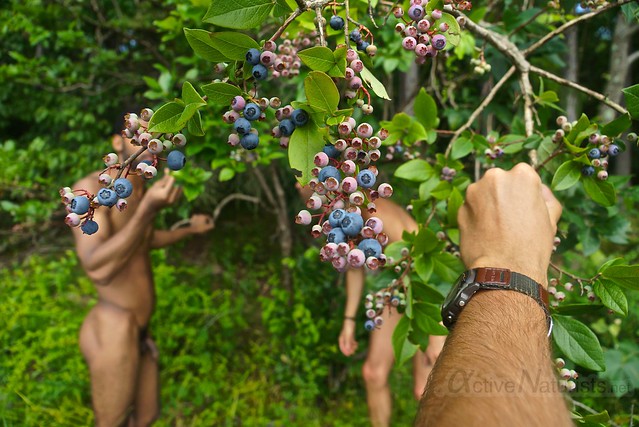
Last summer, we had a very fruitful (quite literally) blueberry season. Sometimes we couldn’t help but stopped to get a mouthful of blueberries, which hindered hikes quite a bit.

naked blueberries 0000 Harriman State Park, New York, USA

blueberry 0005 Harriman park, NY, USA

Again, this is a very pleasant memory at the time of the year when blueberries sold in New York come from Chile… There are different species of blueberries in the area, with the most notable being the northern highbush blueberry, which mostly grows by the lakes.

blueberry 0004 Harriman park, NY, USA

Lowbush varieties grow throughout the forest. One of them was tastes quite differently from those you get on the market: it is sweeter but also much dryer and its seeds are more noticeable; the berries are almost black.

blueberry 0003 Harriman park, NY, USA

But the best way to pick blueberries that I can think of is probably when you stand in shallow water and have a row of highbush blueberries in front of you (like here at the Pine Meadow Lake).

naturist 0032 Harriman park, NY, USA

You might need to share the most fertile bushes though 🙂 Having known only European varieties of blueberries, I was really impressed that here they can grow so tall.

naturist 0037 Harriman park, NY, USA

Well, but not as tall so that you could climb them. But some trees looked quite inviting…

naturist 0000 Harriman Park, NY, USA

to climb and pose on them.

naturist 0002 Harriman Park, NY, USA

Well, I was able to climb this giant with a smooth and straight trunk and stand on it in a triumphant pose, only because it had fallen.

naturist 0001 Harriman Park, NY, USA

But this one had some curves that was too easy to grab and rest on.

naturist 0038 Harriman park, NY, USA

Despite constant stopping for enjoying the views, picking blueberries and climbing trees, we covered quite large distances on our walks. We really took it seriously to explore hiking routes of Harriman Park. Unlike in the previous 2 summers, when we usually came with MTA trains to Peekskill or Garrison and then travelled within the park by bikes, last summer we came to the borders of the park by car or NJ transit trains (e.g., to Suffern or Tuxedo), and then explored the park by foot.

naturist 0025 Harriman park, NY, USA

It was a good idea to get maps from NY-NJ Trail Conference. The trail system is extensive, but most of the trails are clearly marked and it is pretty easy to follow the map. It’s worth noting that there is no cell service throughout most of the park, don’t rely on mobile maps.

naturist 0028 Harriman park, NY, USAnaturist 0039 Harriman park, NY, USA

So, after staring at the map for a couple of minutes, most of the time, we knew where we were heading to. There is a colour scheme for the trails, so look for colour signs on trees and rocks. I think there might be another, more natural way of labelling the trails – by planting mushrooms of different colours. This silly thought appeared in my head when I saw a yellow mushroom growing on yellow trail.

mushroom 0000 Harriman park, NY, USA

Last summer was also a good season for mushrooms and they came in all shades.

mushroom 0003 Harriman park, NY, USAmushroom 0004 Harriman park, NY, USAmushroom 0001 Harriman park, NY, USAmushroom 0002 Harriman park, NY, USAmushroom 0007 Harriman park, NY, USA

Not all of them were that bright, of course, but overall, we wished we knew about local mushrooms. I bet we missed some tasty ones.

mushrooms 0006 Harriman park, NY, USA

As to the trails themselves, they are pretty diverse too. You can have some nice flat grassy trails,

naturist 0027 Harriman park, NY, USA

uphills,

naturist 0022 Harriman park, NY, USA

sometimes steep uphills,

naturist 0034 Harriman park, NY, USA

and downhills, 🙂

naturist 0011 Harriman Park, NY, USA

rocky slopes

naturist 0000 Harriman park, NY, USA

and flat rocks – usually along the springs

naturist 0031 Harriman park, NY, USA

or on hilltops

naturist 0009 Harriman Park, NY, USA

– have I mentioned the views?

naturist 0010 Harriman Park, NY, USA

Some trails are pretty wide and could even fit a car, because they are actually descendants  of roads that served the mines in this area decades ago.

naturist 0033 Harriman park, NY, USA

In some places. the trail appears almost man-made, as it goes on a smooth flat rock surrounded by grass. I appreciated those parts especially when I was walking barefoot, which I’ve been practicing actively for 2 summers now.

naturist 0005 Harriman Park, NY, USA

And speaking of rocks, there are some quite spectacular ones. This one looks as if fallen from out of space with such force that it was split in half.

naturist 0016 Harriman park, NY, USA

This one reminded me a fish head.

naturist 0009 Harriman park, NY, USA

Others might not be that eye-catching but were nice to rest on.

naturist 0043 Harriman park, NY, USAnaturist 0044 Harriman park, NY, USAnaturist 0003 Harriman Park, NY, USA

If it’s too small to lie on it, it may be good enough for planking. I never considered the trend of planking (even naked one) particularly entertaining, but somehow I got inspired for it seeing all those flat rocks.

naturist 0004 Harriman Park, NY, USA

Still, sitting and observing a beautiful lake sounds more appealing.

naturist 0007 Harriman Park, NY, USA

It’s hard to resist to go for a swim after a hot day even if you’re tired 😉

naturist 0006 Harriman Park, NY, USA

Later on, we the sky turned into a bright palette of red colours.

naturist 00000 Harriman Park, NY, USA

But if there is no lake nearby, you’re like to stumble upon one of numerous springs.

naturist 0005 Harriman park, NY, USA

Many of them are deep enough for a [skinny] dip.

naturist 0008 Harriman Park, NY, USA

By the way, our affection of swimming didn’t go unnoticed. Once, when my friend Sasha and I were about to leave the Pine Meadow Lake, two guys from India approached us and started a conversation. You might think that they were curious to see two naked guys in the woods – and indeed they were 🙂 – but one of them didn’t know how to swim and he asked us to teach him.

swimming lesson 0045 Harriman park, NY, USA

Maybe I look professional in my goggles, or maybe they just saw that I was away in water for half an hour. In any case, I am glad he got inspired and I guess we’ll continue his lessons next summer.

naturist 0029 Harriman park, NY, USA

Another highlight was discover of a shelter.

naturist 0023 Harriman park, NY, USA

Later, we found on the map that there were a few of them in the park, which is good to know in case of unexpected bad weather.

The Pine Meadow Lake was definitely our favourite hangout in Harriman Park last summer.

naturist 0035 Harriman park, NY, USA

Besides aforementioned blueberry bushes, it attracted us with its beautiful views, as well as with minuscule islets where one could pose like a stork,

naturist 0036 Harriman park, NY, USA

or imagine yourself a Gulliver.

naturist 0024 Harriman park, NY, USA

And of course we had many opportunities to observe and photograph wildlife again.

chipmunk with mushroom 0008 Harriman park, NY, USA

However, last summer, it wasn’t the mammals that caught my attention most of the time.

naturist photographer 0030 Harriman park, NY, USA

Dragonflies seemed to queue up to get photographed,

dragonfly 0012 Harriman park, NY, USAdragonfly 0010 Harriman park, NY, USA

sometimes even two at once.

dragonflies 0010 Harriman park, NY, USA

This is some kind of blue wasp.

blue wasp 0013 Harriman park, NY, USA

And this is a parasitic wasp that was looking for insects in the bark to lay her eggs – I noticed it while climbing that curvy tree that I mentioned above.

wasp 0006 Harriman park, NY, USA

Butterflies were abundant too. It was interesting to see tiger swallowtail

butterfly tiger swallowtail 0011 Harriman park, NY, USA

next to its relative spicebush swallowtail with almost inverted colours.

butterfly 0009 Harriman park, NY, USA

Although butterflies are the easiest to spot among insects, it’s not that easy to take a decent photo of them due to their unpredictable movement pattern. This grasshopper turned out to be a much better model!

grasshopper 0041 Harriman park, NY, USA

It jumped on my shoulder and waited patiently while we were photographing. Too bad the light was low.

grasshopper & naturist 0040 Harriman park, NY, USA

Another great poser was this northern water snake.

northern water snake 0042 Harriman park, NY, USA

Once it went in water, it revealed its bright skin.

northern water  snake 0015 Harriman park, NY, USA

It was circling in the same spot and seemed to be looking for something without paying too much attention to us.

northern water snake 0014 Harriman park, NY, USA

Soon we saw what it was up for.

american bull frog 0018 Harriman park, NY, USA

There was a pretty big American bull frog hiding quietly under grass.

american bull frog 0017 Harriman park, NY, USA

Then slowly it moved away. On another hike, we witnessed a less lucky situation (for the frog). I heard a squeaking sound from under a rock and saw a snake swallowing a frog (well, lucky snake then).

snake eating frog 0008 Harriman park, NY, USA

OK, enough of this wildlife drama for the start of new year! I just wanted to say again that  were happy to explore outdoors next to New York City, happy to see that the park seem to be in a healthy condition (except for some spots where people leave their trash, as I mentioned in the previous post). Lichens covering rocks and trees are a good indicator or clean air.

lichen 0005 Harriman Park, NY, USA

I’m so looking forward to the summer and exploring Harriman park further!

naturist 0026 Harriman park, NY, USA

kayaking in Cold Spring Harbor

As Juan wrote in his first blogpost, kayaking, although often overlooked, is probably the easiest outdoor activity to practice in the buff without anyone noticing. It’s hard to tell whether one wears shorts, speedos or… nothing 😉

Last sumer, I had a couple of fun kayak trips with a few buddies in and around Cold Spring Harbor in Long Island.

Cold Spring Harbor hosts the world-famous laboratory that contributed to the discovery of the double helix structure of DNA. Most of the land along Cold Spring Harbor and Oyster Bay is privately owned, but you can definitely explore the area by the sea.

Once you reach the edge of the Oyster Bay, you could head out to the open waters of Long Island Sound

or turn Eastwards in the direction of Caumset State Park.

This is how it looks from the air (these photos were taken on another occasion, obviously).

To reach the beach of Caumset Park, you need to paddle around the sand spit that is a part of private land. You won’t see many people on the shore, perhaps a lonely fisherman.

Once you go around the tip of the sand spit, you will see a beautiful beach of Caumset State Park.

It is surrounded by lush forest which gives it almost tropical appearance.

Cormorants seemed to to be the only ones to welcome us.

The beach doesn’t see many visitors, it has a touch of the lost world…

Which also meant we could stay there as nature intended, without clothes 🙂

The sand cliffs appeared to be even prettier than from afar, revealing different shades of orange and pink.

Some shorebirds, possibly sand martins, have a colony there; my friend Martin :D, who climbed the cliffs couldn’t confirm what they were, we didn’t see any birds leaving the nests.

We enjoyed viewing the scenery for a bit and strolled along the beach.

Low tide revealed a lot seaweed, that tried to anchor at anything solid.

We found a flat white rock that was perfect for a lunch break,

and a golfinch was pleasing our ears while we took a nap…

On another occasion, we actually did some jumps instead of a nap 🙂

After the nap, we discover that a storm was on our way. The forecast for the day was ambiguous, but we were not anticipating to paddle in the sea during a thunderstorm!

We prepared to leave hastily, but as soon as we got on water, the sky started clearing ahead of us and we just tried to escape from the menacing clouds.

It got quiet again.

The storm seemed to get sucked into the Atlantic Ocean over Long Island.

The only place where we got a bit worried again, was around the tip of the sand spit that I mentioned above, because it gets quite strong currents and waves during tide change.

But it wasn’t a challenge after all, and we got back safely. We definitely look forward to more kayaking!